
EAR1 Remote Station Atlantic
Image
Reply
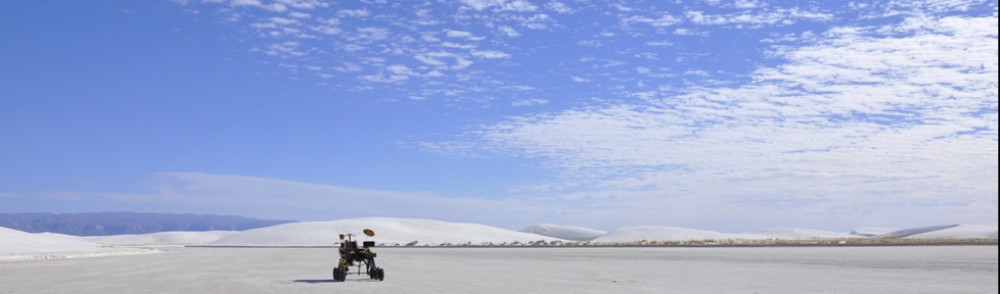
Exploring a Playa at the southern end of the Jornada Plain. Playas are some the flattest land forms in the world. Usually the lowest point in the desert basin they collect waterfall during the monsoon season. However this Playa has seen little to no rain in a very long time. EAR1 and Mission Control listen to this place.
The Jornada is a valuable resource for long term ecological research with studies and data logged for over a hundred years. The core melody for this tune is based on the long-term research of various types of declining grasses on the Jornada Experimental Range. EAR1’s TEMP instrument determined the key in which the song is played should be G#. or 104 degrees. The lyrics comprise a standard ecological description and precipitation data.
White Sands Mission Sol 138
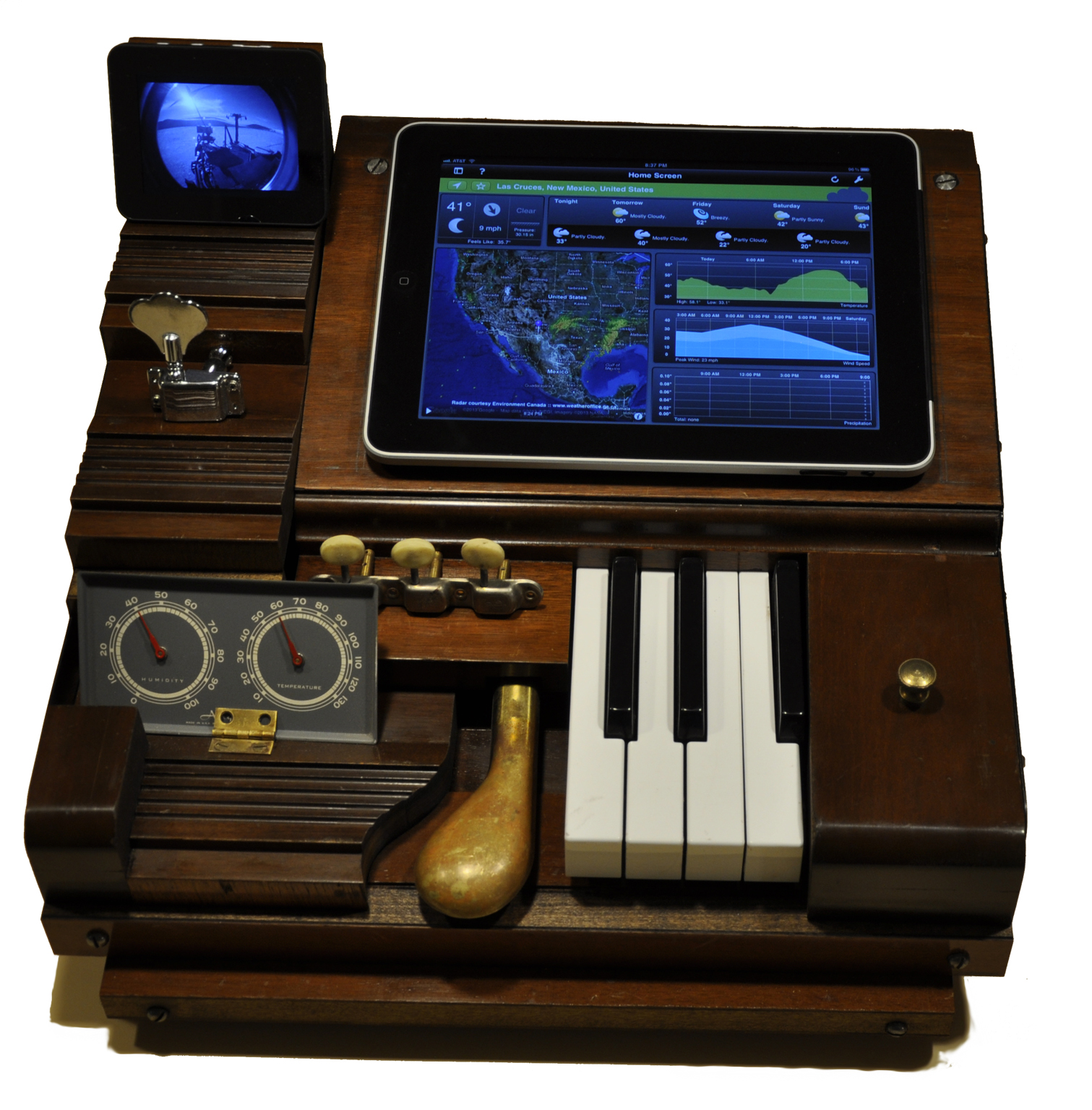
C is forward. C# is reverse. D turns left and D# turns EAR1 right.
This remote control is in progress. It controls EAR1 up to 100 feet away. As I progress I will be adding new parts to the composition to create remote control ecological jam session weather station harmony.
First a statement:
Through research and experimentation, I am developing tools to experience the nature of audio and visual languages. These apparatus of my art practice are manifested through my research of neuroscience, music, visual art, linguistics and the related biological mechanics and syntactic structures of each.
These tools will provide me a vocabulary to initiate dialogue with the science community with the goal of synthesizing a formal output to ultimately provide new perceptive experiences for myself and others.

The premise of the EAR1 rover project is to explore language between art and science using music as a vehicle. Inspired by a conversation I heard between Roger Malina and Sundar Sarukkai, Martyn Woodward, and Michael Punt, I use the art/object and the science/instrument to think through object, rather than think about the object. EAR1 is looking for the imperceptible to explore.
Neuroscience exploring perception shows us that audio and visual recognition is a natural human skill that takes place within milliseconds, yet we understand very little about it. Recognition as an element of language is key to my project as we know that sound and image through our perception triggers meaning.
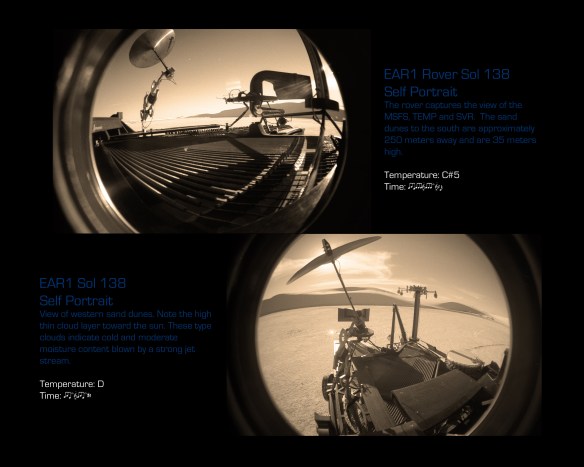
The rover is a tool I am developing to explore the terrain of audio visual perception between the languages of art and science as EAR1 begins an exploration of environments. These environments may or may not be familiar depending upon perceived meaning to the viewer and listener. The environments will be varied and will grow to create a global composition of language describing a place for life.
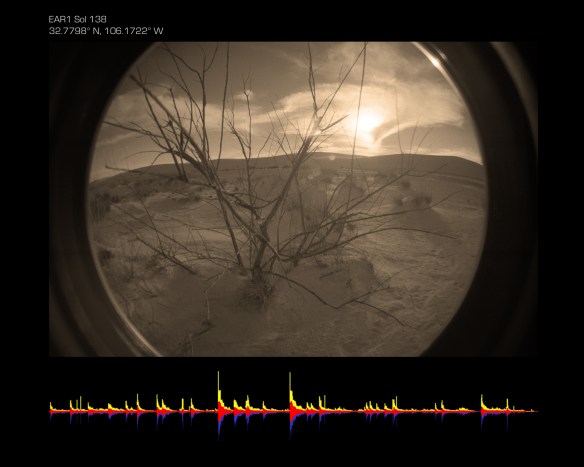
EAR1 mirrors, on Earth, the method of NASA Curiosity on Mars by collecting, encoding, and reporting “data”. Curiosity can only look and report. EAR1 has the capability of looking, listening, and expressing. By expressing I mean the rover can be played as an instrument. One element of EAR1s missions emulates the methodology of science as musicians will play the rover as they collect information through their senses and perception, and synthesize it into art data or language. These collections form the compositions that score the video of EAR1 journeys.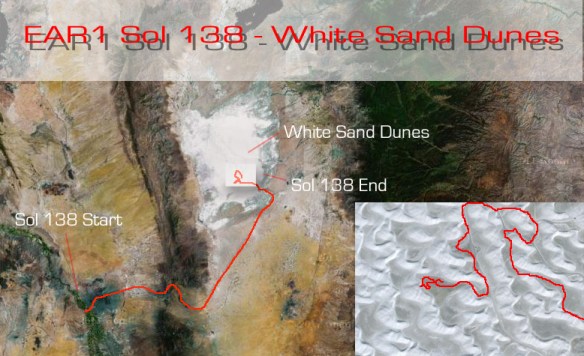
The above satellite image shows the path that EAR1 explores on Sol 138. Below is video captured by EAR1 as it roams the dunes of White Sand. The sound is is a composition environment collected by EAR1, and of the perceptions and expression thereof by me.
EAR1 begins listening on Earth. recorded composition is played by mulberry leaves, tree, and wind. Recording occurred on sol 104 (104th day since curiosity landed on Mars) The temperature is a warm fall 69 degrees (C#). Still many bugs to work out.
What really is the sound of a piano?
Here I’m testing the sound of wind through the “instrument”. It is apparent that more work is needed to make the “action” wind speed instrument (WSI) more sensitive to lower wind speeds. This is about a 40 mile an hour wind. I would say wind shares the physical property of sound as it does produce the energy of pressure. However it doesn’t create sound until it reacts with something resistant and resonant. This is the nature of sound. The EAR1 is an instrument of resonance.
As the turbine rotates it plays the wind through the vibration of its natural properties. However the properties of the wind meter have been altered many times from their natural acoustic properties: much like how musical instruments are altered to provide desired tone, timbre, and volume. The WSI parts first existed as minerals, a sheep’s wool coat, and trees. It was then harvested from the earth to produce raw material, forged into parts cut for a design, and then used for the construction of a 1949 spinet piano. I then plucked these parts from their 64 year life as a piano, and re-purposed them as my one raw material, newly designed parts and ultimately my new wind speed instrument.
A piano is a highly altered grouping of raw material. When the material is fashioned into a mechanical composition, we know to be the “piano”, it produces a voice. Raw earth gave birth to this voice and it has changed little in centuries. It is the perception of this voice that I am interested in. The very same raw materials that orchestrated a resonate voice for the last 64 years, are now resonating with a new voice. Additionally they are actuated by a new force. The force of wind. I propose the new piano voice , now titled EAR1, is just as valid to the luthier, artist, and listener. What does it reveal? I will explore the earth in which the raw material comes.
When I was six I was struck by how the audio and visual of the Apollo missions was so crude. As a child and as an adult I find the rudimentary quality of the Apollo films to enhance my perception of distance and time. It is surreal as far as an earthly experience is concerned.
In PianoScape1 the sound track is an edited sampling of sounds I make as I work on the EAR1 rover.
Psychology tells us that perception is the organization, identification, interpretation, of sensory information, in order to represent and understand our environment. John Cage opened up our perception to music by demonstrating how any sound becomes music and art if we employee active listening.
I’m interested in new frontiers of sound were we can go to and listen with the perception of music/art being the landscape, and sound is the atmosphere. I believe these frontiers are endless so I am building my own rover to explore perceptive “listening” and possibly “seeing” in one of these not so distant times and spaces.

Loading The MPS (Main Piano Sensor)
Inspired by the scientific adventure of Mars rover Curiosity playing out 140 million miles from earth, I’ve begun a project called EAR1 (Earth Aural Rover). As I think about Earth and Mars I think of it in terms of “here and there”. Although in the larger picture of the universe they are both “here”, it is difficult to really perceive this vast space/time environment and really where I am standing in it. I can read, do the math and look at the models of this environment, yet unless I experience it, I don’t think I’ll get it truly.
This sublime scientific expedition is a fascinating quest as our human civilization probes the Mars surface, collecting information for our better understanding of the Mars environment. The 10 plus testing instruments on board the Curiosity Rover are amazing technological achievements, but apparently we are not curious as to what Mars sounds like, because there are no devises listening. We didn’t put an ear on board. We sent back music i.e. “Reach for the Stars” by Will.i.am but this came from here not there.
So “there” remains silent, but “here” is another story. This planet is overflowing with sound. So “Here” seems like a good place to explore sound. I started thinking about how and why we explore sound on this planet. We listen with our ears. We record it and amplify it with technological devises. We also make sound to explore it. As a musician the latter seems like a logical way to me, as the experience is loaded from the inside out. The idea of exploring sound expression through music is a human way to perceive the time/space of ourselves. The distance between ourselves and the perceived potential of ourselves is infinitely farther than from Earth to Mars.
So the testing of listening devices that will be on board EAR1 begins. here is the first test.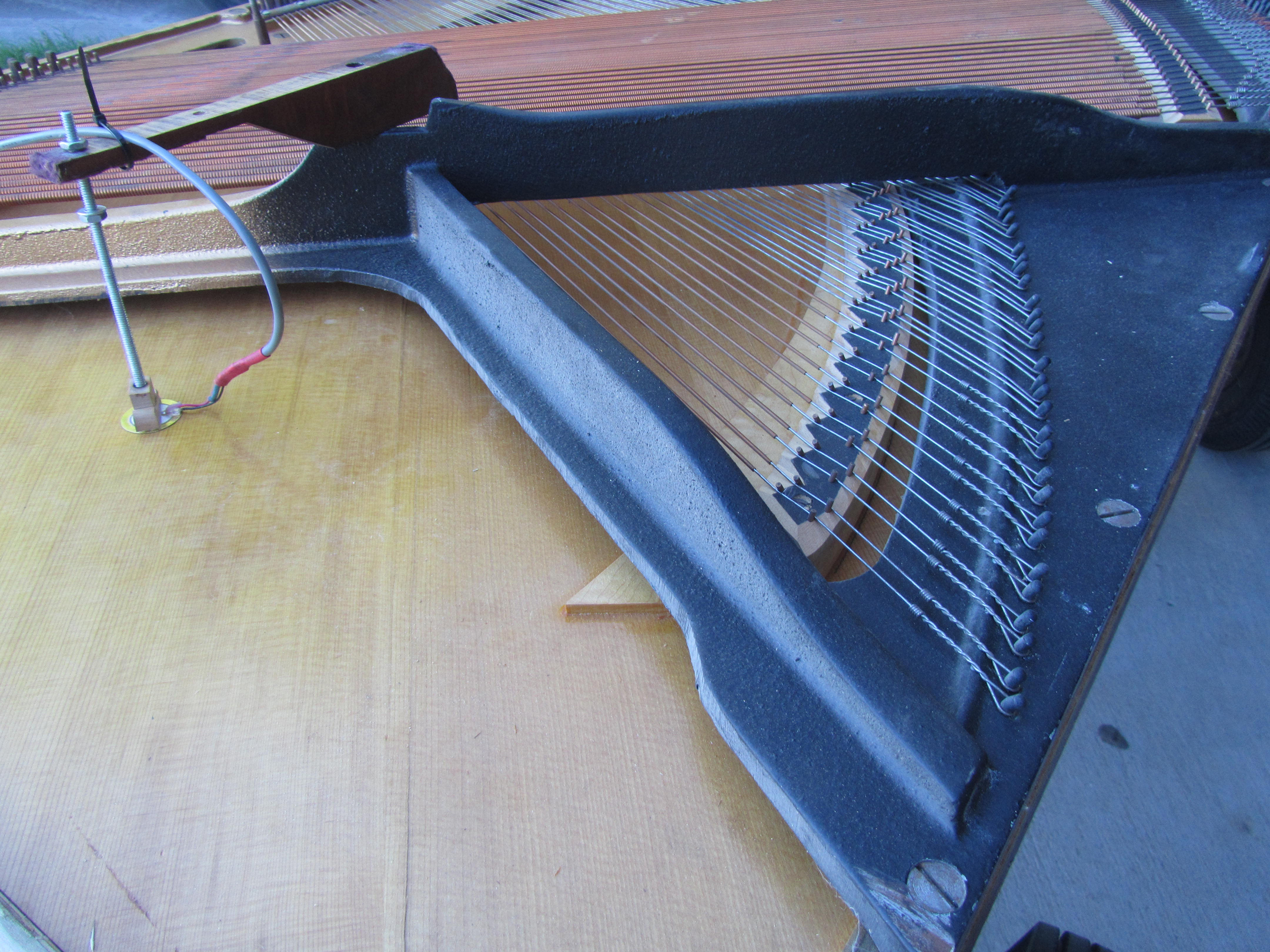
 EAR1
EAR1 